


Resources
Discover a wealth of materials designed to support gifted children and their teachers in New Zealand.
Here, you'll find carefully curated books, articles, and links to further resources aimed at nurturing the unique talents and abilities of gifted learners.
Books
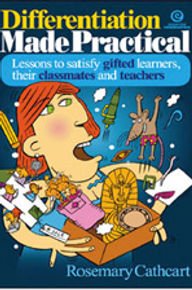
The three books listed below are collectively designed to provide teachers with thoroughly practical and very accessible information about providing for gifted learners.
The approaches and strategies they set out have proven effective with students from early primary through to senior high school. They are based on decades of work directly with gifted learners, supported by the research in this field. And they are designed to be user-friendly too – very readable, sharing the fun and delight of working with these interesting learners and their often unexpected ideas!
All these texts are available in New Zealand and generally in Australia and through sites like Amazon

They’re Not Bringing My Brain Out:
Often described as the “bible” by teachers who use it, this classic New Zealand work features multiple examples from real lessons and real children’s work and easy-to-follow text to support its comprehensive coverage of this fascinating subject.
Affectionately known as TNBMBO, it’s now in its 4th edition, published by Routledge UK.

Articles
The first article listed below, by award-winning writer Stephanie Tolan, is possibly the most influential ever written on gifted children, as insightful today as when it first appeared.
Next we include an important new document, the Charter of the Rights of the Gifted Child.
The remaining items, some long, some short, cover a wide range of those issues perennially relevant to understanding and responding to gifted individuals, beginning with a poster and ending with an anonymously submitted paper on one of today’s most sensitive topics.
NB: All material presented here is subject to copyright. Copyright will normally be freely given, but please contact us if you wish to use this material for more than simply citation. Thank you!

Is it a cheetah?
Translated into over 40 languages and published here with the kind permission of the author, this simple short article has created the most powerful analogy of the gifted child that we have.
> click HERE
For more by Stephanie Tolan, see her website www.stephanietolan.com
The Charter of Rights for the Gifted Child:
Prepared by delegates at the 50th anniversary conference of the NZ Assn for Gifted Children, Christchurch, September, 2025.
Time to change the metaphor?
Historically the most-used symbol for bright youngsters was perhaps the shooting star. Is there a symbol which could be more appropriate for today?
The Gifted Child who is Māori.
Two teachers, one Māori, one Pakeha, become engaged in a busy debate on this topical subject!
Gifted Is as Gifted Does:
Why is this quote so apt?
How can it help us to cater for the gifted learner?
Education Today, Issue 5, 2004
Parenting a Queer Gifted Child:
A parent speaks thoughtfully and honestly about the issues involved when a gifted child recognises themselves as non- binary in gender.
Aiming for Excellence – or Not?
“Excellence” is a perfectly valid objective for the high achieving student. Is it a valid objective for the gifted learner?
This short one-pager explores this possibly surprising question and comes up with some thought-provoking considerations.
Unconventional Comprehension.
An example of an unexpected high-interest approach to adapting classroom tasks for the gifted learner.
Effective with topics at all age levels.
Identifying gifted learners in Aotearoa New Zealand.
A questionnaire especially developed for our bi-cultural and holistic approach to learning.
The Conundrums of Success:
An extended in-depth discussion of a central question for gifted education: what does success mean for gifted learners?
This paper challenges the traditional interpretation of success as high academic achievement or measurable performance. It puts forward an inspirational re-definition reflecting a whole-life vision for the gifted child.
First presented as the keynote for the Australian Assn for the Education of the Gifted and Talented national conference in 2008, then requested by Dr Linda Silverman for the US Gifted Development Center’s website, and later again presented in an edited version for the NZAGC 40th Anniversary Conference in 2015.